
Engineering you can see in the canopy.
Our aircraft are chosen for one job: repeatable, even application over Tamil Nadu fields. Here is what is inside them and how we operate them.
- RTK accuracy
- ± 10 cmRTK accuracy
- Tank capacity
- 10–20 LTank capacity
- Spray width
- 4–7 mSpray width
- Obstacle sensing
- 360°Obstacle sensing
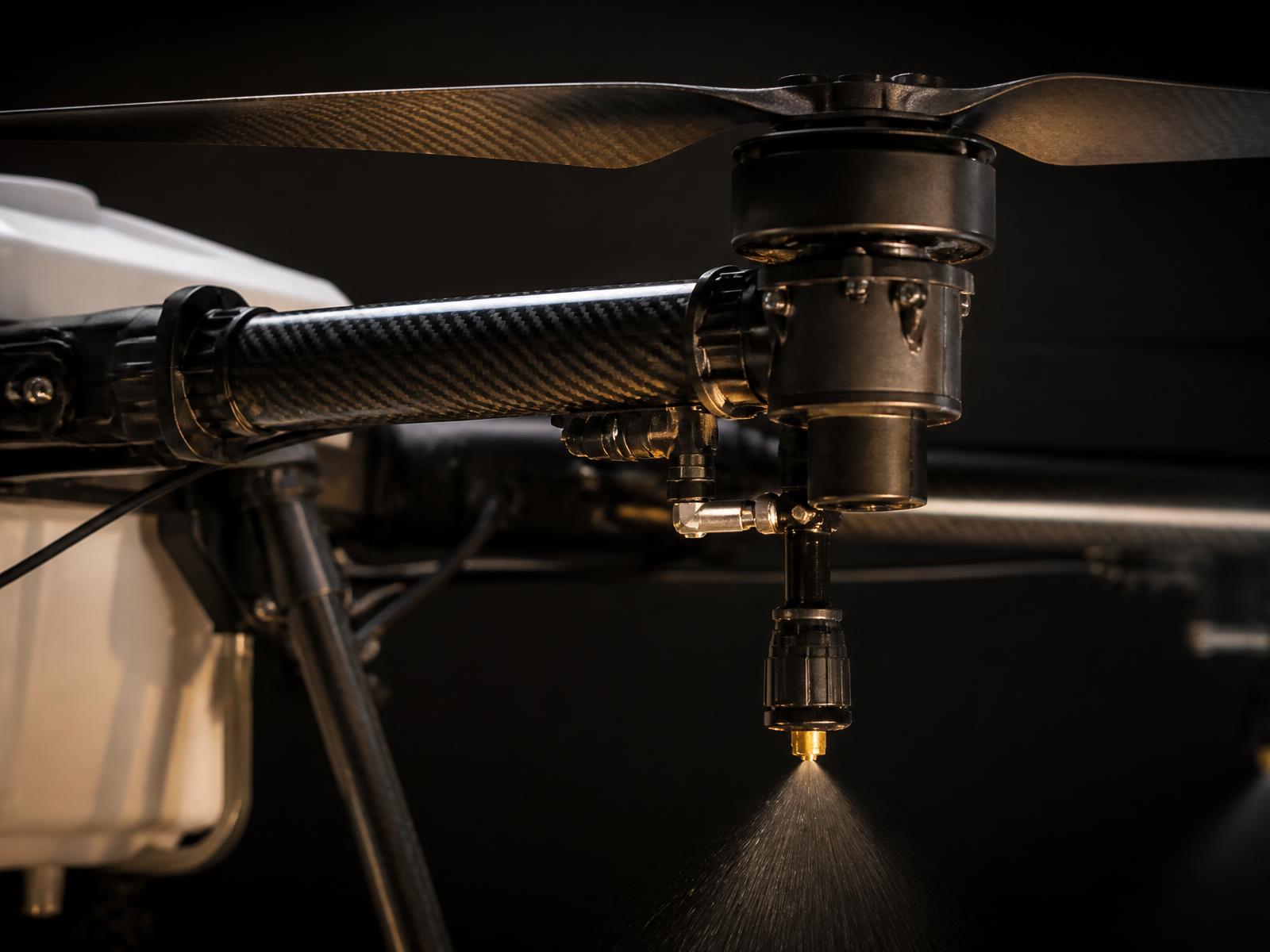
Aerospace-grade hardware, tuned for Indian fields.
Carbon fibre airframes, corrosion-resistant pumps and centrifugal nozzles that hold droplet size steady from the first acre to the last.
- RTK + terrain radar
- Centimetre-level positioning with active height-hold over uneven Tamil Nadu plots.
- Flight automation
- Boundary-mapped missions with automatic route resumption after a refill or battery swap.
- Field power system
- Generator-backed fast charging keeps the fleet airborne through a full working day.
- Tank capacity
- 10 – 20 L
- Spray width
- 4 – 7 m
- Flow rate
- Up to 8 L / min
- Positioning
- RTK ± 10 cm
- Obstacle sensing
- Omnidirectional radar
- Field endurance
- 4 – 6 acres / hour
Four subsystems that decide spray quality.
Coverage is not about speed alone. It is the combination of droplet control, height hold, route accuracy and uninterrupted power.
Spray system
Pressure-fed nozzles produce a controlled droplet spectrum, with flow adjusted to the application rate so coverage stays even from the first pass to the last.
Terrain radar & RTK
Centimetre-level positioning with active height hold, so the boom stays at a constant distance above an uneven canopy or bunded plot.
Mission planning
Plot boundaries are mapped before the flight. Missions resume from the exact break point after a refill or battery swap — no double spraying, no missed strips.
Power and logistics
Smart batteries with field charging support keep the aircraft cycling through the calm morning window instead of waiting on the ground.
Fleet specifications at a glance.
- Tank capacity
- 10 – 20 L
- Effective spray width
- 4 – 7 m
- Flow rate
- Up to 8 L / min
- Positioning accuracy
- RTK ± 10 cm
- Obstacle sensing
- Omnidirectional radar
- Typical field endurance
- 4 – 6 acres / hour
- Operating window
- Low-wind morning and evening
- Water use vs knapsack
- Around 90% lower
Figures are typical ranges across our fleet. Actual coverage and endurance vary with crop type, field conditions, application rate, weather and operational requirements.
Advanced hardware, disciplined flying.
Operational safety
Documented pre-flight checks, marked take-off zones, spotters on the ground and immediate abort criteria for wind, rain or bystander movement.
Compliance discipline
Registered aircraft, trained remote pilots and DGCA-aligned operating procedures, with airspace and buffer-zone checks before each mission.
Book a free demo on your own field.
The fastest way to judge the technology is to watch a pass over your crop. We will bring the aircraft to you.